Architecture
AURA™ Fleet Service
Automation Architecture
Six-Layer Infrastructure Stack — from grid interconnection to fleet dispatch integration. Every layer purpose-built for unattended, autonomous operation.
Infrastructure Stack
Six Layers. One Autonomous Stack.
Layer 1
Fleet Dispatch Integration
SOC data, mission schedule, readiness confirmation. The interface between fleet operations and service infrastructure.
Layer 2
JouleOS™ Orchestration
Per-site and cross-network coordination. Real-time scheduling, energy balancing, and SLA enforcement.
Layer 3
AURA™ Zero Touch™ Automation
Autonomous charging, inspection, cleaning, validation. The physical execution layer eliminating human intervention.
Layer 4
Charging & Energy Layer
DC fast charging, BESS, switchgear, metering. Energy infrastructure scaled to fleet throughput demands.
Layer 5
Site Infrastructure
Zoning, access control, modular service bays. Physical site topology designed for autonomous vehicle flow.
Layer 5
Grid & Utility Foundation
Interconnect, transformer scaling, demand response. The electrical backbone enabling high-power fleet servicing.
Topology
Scalable Site Typologies
The architecture deploys consistently across every scale — from localized edge nodes to high-throughput core facilities.
Type C
Spoke Site
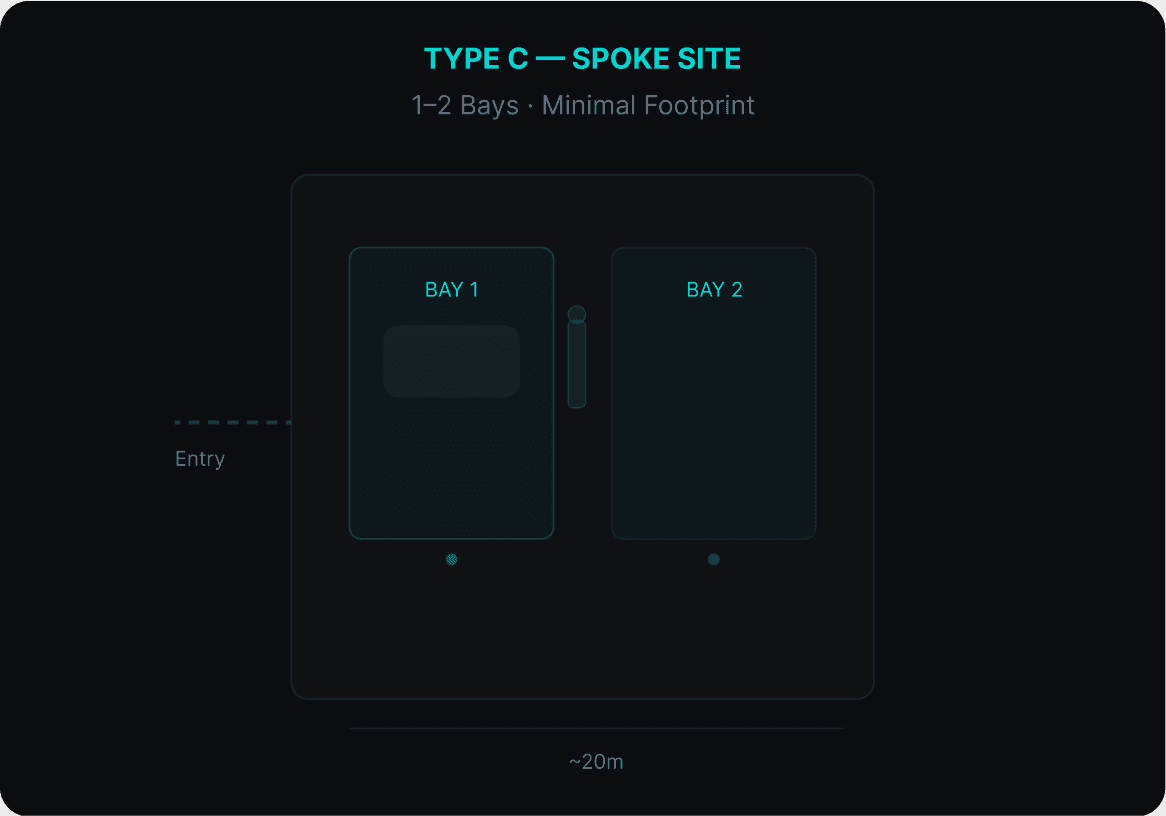
Minimal footprint for distributed fleet touchpoints.
Type B
Hub Site
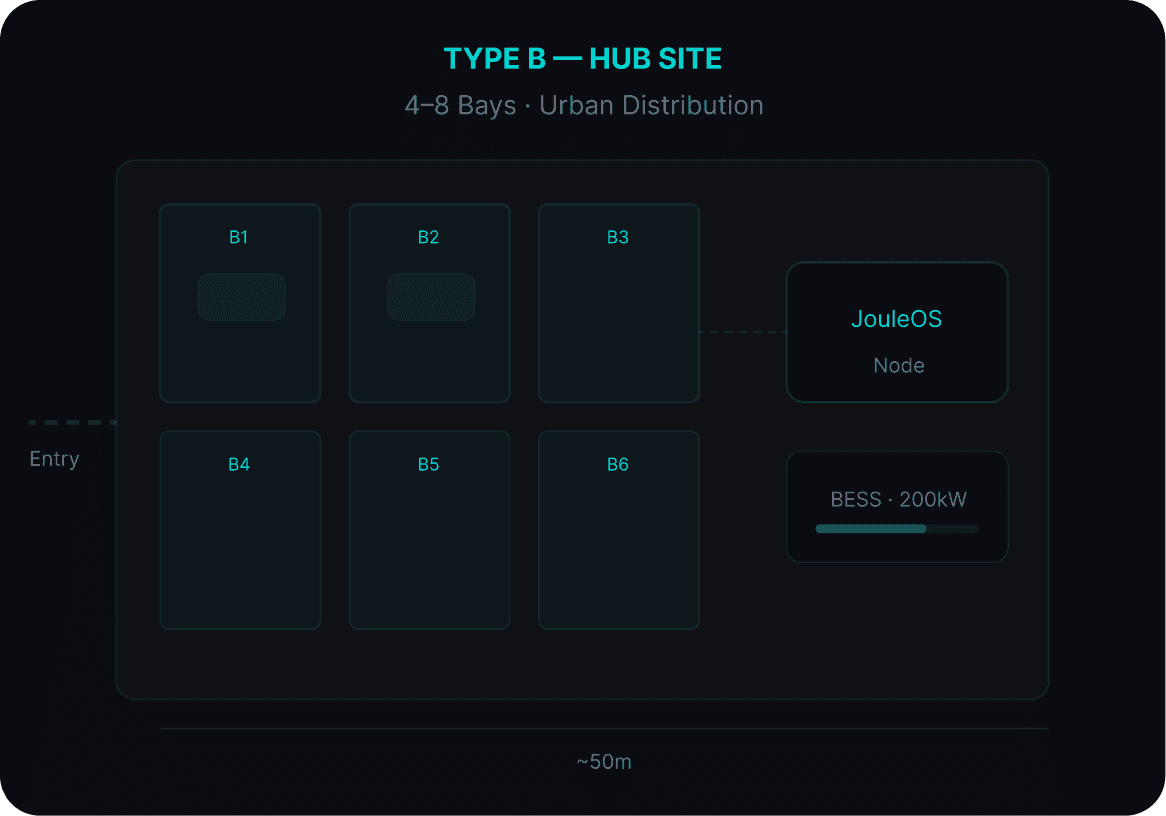
Multi-vehicle throughput with cross-site load optimization.
Type A
Core Depot
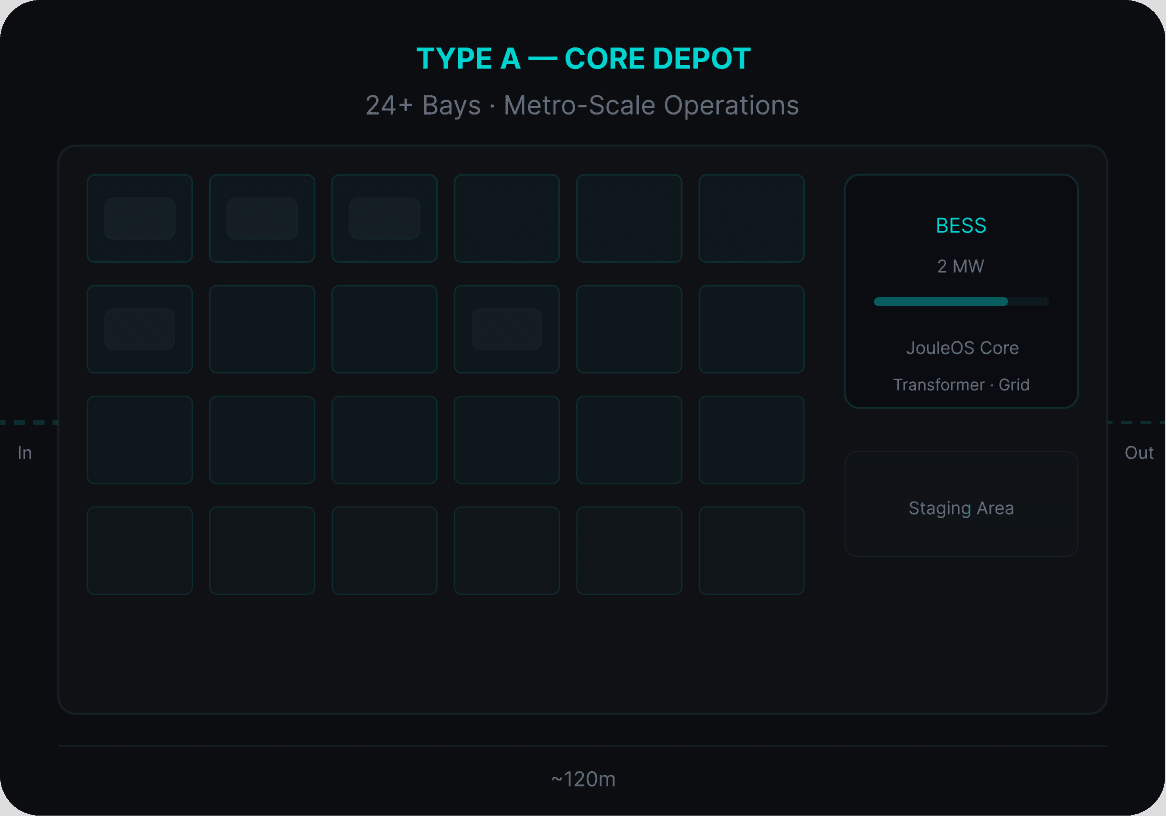
Metro-scale operations with full AURA deployment.
Design Principles
Dark Site Architecture
The AURA architecture enforces operational invisibility. Service congestion is eliminated before it forms.
Infrastructure becomes operationally invisible.
Learn More